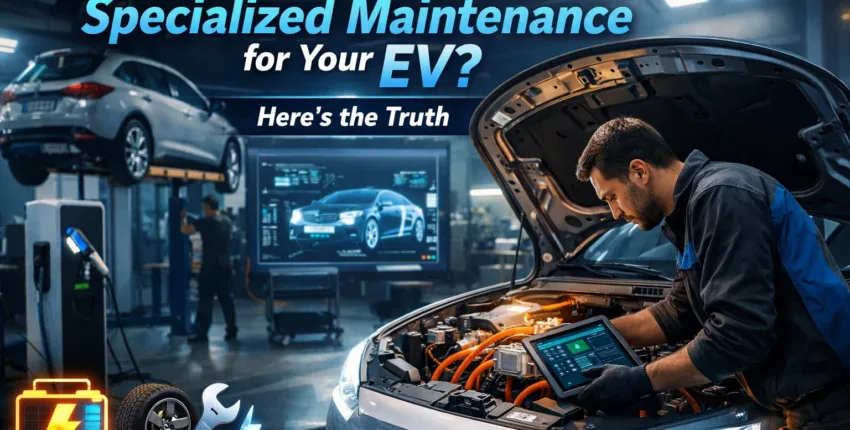
You finally did it. You traded in the internal combustion engine for a sleek, silent electric vehicle. Maybe it was the desire to skip the gas station lines on East 14th Street, or perhaps you just wanted that instant torque when merging onto the I-880. One of the biggest selling points you probably heard was: “EVs are basically maintenance-free.”
It sounds like a dream, right? No more oil changes, no more spark plugs, and no more worrying about timing belts. But as you settle into EV ownership here in San Leandro, a nagging question starts to creep in: Is it really that simple? Or am I setting myself up for a massive repair bill down the road because I ignored something “specialized”?
At JC Auto Repair, we’ve seen it all. From the classic domestic cruisers to the latest high-tech imports, we know that every vehicle, regardless of what’s under the hood, is a significant investment that needs protection. Today, we’re stripping away the marketing hype to give you the honest truth about EV maintenance.
The “Maintenance-Free” Myth: What’s Actually Gone?
Let’s start with the good news. There is a lot of truth to the idea that EVs are simpler. A traditional internal combustion engine has hundreds of moving parts. You’ve got pistons, valves, crankshafts, and an exhaust system that all require precise lubrication and cooling.
When you go electric, about 80% of those moving parts vanish. Here is what you can officially cross off your car maintenance to-do list:
- Oil Changes: Since there’s no engine oil to lubricate combustion components, the days of the 5,000-mile oil change are over.
- Spark Plugs & Ignition Coils: No combustion means no need for a spark.
- Transmission Repairs: Most EVs use a single-speed transmission, which is far less complex than a traditional automatic or manual setup.
- Mufflers and Exhaust: No emissions, no exhaust pipes to rust out.
While this is a huge relief for your wallet, it often leads to a dangerous mindset: complacency. Just because your car doesn’t have an engine doesn’t mean it isn’t a machine that interacts with the road, the weather, and the physics of driving.

The Heavy Truth: Why Your Tires Are Screaming for Help
If there is one thing that surprises new EV owners more than anything else, it’s how fast they go through tires. You might think, “I’m a careful driver, why are my threads disappearing?”
Here is the technical reality: EVs are heavy. Batteries are dense, often adding 800 to 1,500 pounds compared to a similar gas-powered car. Combine that extra weight with “instant torque”, the ability of an electric motor to provide full power the second you touch the pedal, and you have a recipe for rapid tire wear.
Without a regular mechanic in San Leandro, CA checking your alignment and rotation, you could be looking at replacing a full set of tires in as little as 10,000 to 15,000 miles. That’s why following 10 easy maintenance tips to extend the life of your tires is even more critical for EV owners than for gas-car owners. Specialized EV tires are designed with stiffer sidewalls and different rubber compounds to handle this stress, but they still need a professional eye to ensure they’re wearing evenly.
Regenerative Braking: The Blessing and the Curse
One of the coolest features of an EV is regenerative braking. When you lift your foot off the accelerator, the motor reverses, slowing the car down and putting energy back into the battery. This means you rarely actually use your physical brake pads.
The Problem: Because the physical brakes are used so infrequently, the calipers, sliders, and pads can actually seize up from disuse. In our coastal San Leandro climate, moisture and salt air can lead to corrosion on brake components that never get “cleaned off” by the heat of friction.
The Agitation: Imagine needing to slam on your brakes to avoid a distracted driver on Hesperian Blvd, only to find your brake calipers are stuck or your rotors are severely rusted because they haven’t been engaged in months.
The Solution: You don’t necessarily need a “specialist,” but you do need an auto repair San Leandro shop that understands how to perform a “brake service and lubrication” even if the pads look brand new. Ensuring those moving parts stay moving is a vital part of your general maintenance checklist for long-term vehicle health.

The Cooling System: Not Just for Engines
Wait, if there’s no engine, why is there a radiator?
This is where “specialized” knowledge starts to matter. EV batteries and power electronics generate a significant amount of heat, especially during fast charging or long drives. To keep the battery in its “happy” temperature zone (which extends its life), EVs use a complex liquid cooling system.
This coolant doesn’t last forever. Over time, it can become acidic or lose its effectiveness, which could lead to your battery overheating. A battery replacement is the single most expensive “repair” an EV owner can face, often costing more than $10,000. Frequent checks of your thermal management system are essential. Battery services explained aren’t just for 12V lead-acid batteries anymore; they are about protecting the heart of your electric vehicle.
Do You Really Need a “Specialized” EV Shop?
Here is the truth: For 90% of your maintenance needs, you do not need to go back to the expensive dealership or a boutique EV-only shop.
While the high-voltage battery and the drive motors are specialized components, the rest of the car is still… a car. It has a suspension, a steering rack, cabin air filters, brake fluid, and tires.
- Brake Fluid: Just like a gas car, EV brake fluid is hygroscopic (it absorbs water). It needs to be tested and flushed every two years to prevent internal rust.
- Suspension: The extra weight of an EV puts more stress on bushings, struts, and ball joints. OEM-grade repairs are vital to maintaining that smooth, quiet ride you love.
- Cabin Air Filters: These keep the San Leandro pollen and 880-exhaust out of your lungs. They should be changed yearly.
At JC Auto Repair, we pride ourselves on being a trustworthy partner for all makes and models. Whether you drive a domestic Chevy Bolt or an imported BMW i4, our team has the tools and the expertise to handle the routine maintenance that keeps these cars on the road.

The “Check Engine” Light on an EV
Yes, EVs have warning lights too. While you won’t get a light for a loose gas cap, you might see alerts for electrical system faults or cooling issues. Ignoring these can be just as dangerous as ignoring a knocking engine.
If you see a warning on your dash, don’t panic, but don’t wait. Understanding why your electrical systems deserve a professional inspection can save you from a “brick” car that won’t start in your driveway. We use advanced diagnostics to communicate with your car’s onboard computers, identifying the root cause before it turns into a major headache.
Local Care for Local Drivers
Driving in San Leandro presents its own set of challenges. We have the stop-and-go traffic of the Bay Area, the hills that put extra load on our motors, and the coastal air that can accelerate corrosion. Your EV is a “significant investment,” and treating it like one means more than just plugging it in every night.
Think of car maintenance like your own health. You don’t wait until you can’t walk to see a doctor; you go for check-ups to stay ahead of the game. Your EV deserves the same courtesy.

The JC Auto Repair Promise
We know that the transition to electric can feel a bit overwhelming. There’s a lot of new terminology and plenty of myths floating around the internet. Our goal is to provide a casual, transparent, and expert experience every time you walk through our doors.
We aren’t here to sell you “magic EV oil” or unnecessary services. We are here to ensure your tires are safe, your brakes are responsive, your fluids are clean, and your battery is cooled.
So, do you really need specialized maintenance for your EV? You need smart maintenance. You need a team that respects the technology but understands the mechanical fundamentals that keep every vehicle safe on our San Leandro streets.
Ready to make sure your EV is in peak condition for the road ahead? Whether it’s a simple tire rotation or a deep dive into your cooling system, we’re here to help. Contact us today or stop by the shop. Let’s keep that investment of yours running smooth and silent for years to come.